Samsung Biologics Analysis: Record Profit, 45% Margins
This Samsung Biologics analysis examines a company that just posted $3.1 billion in revenue, $1.4 billion in operating profit, and a 45.4% operating margin — the best performance in the history of Korea’s biopharmaceutical industry. Year-over-year revenue growth hit 30% and profit growth 57%. The company’s market cap has surpassed $55 billion (₩79T), making it one of the five most valuable companies on the KOSPI (Korea’s main stock index).
If you’ve been tracking the global CDMO (Contract Development and Manufacturing Organization) space, you’ve likely noticed the seismic shift underway. The U.S. BIOSECURE Act — signed into law in December 2025 as part of the National Defense Authorization Act — is forcing pharmaceutical companies to rethink their China-dependent supply chains. Samsung Biologics, with the world’s largest single-site biomanufacturing capacity, is positioned as the primary beneficiary of this structural reallocation.
Think of Samsung Biologics as the TSMC of biomanufacturing. It doesn’t develop drugs. It manufactures them — at a scale and quality level that most pharmaceutical companies cannot replicate in-house. Seventeen of the world’s top 20 pharma companies are already customers. And the backlog keeps growing: cumulative orders have reached $21.2 billion.
Samsung Biologics is the infrastructure layer of modern biopharma. Drugs change. The company that manufactures them doesn’t.
✔ Samsung Biologics’ record-breaking 2025 financials — and what drives that 45% margin
✔ How the CDMO business model creates structural competitive advantages
✔ Why the BIOSECURE Act, Plant 5, and a new U.S. facility are three simultaneous growth catalysts
✔ How Samsung Biologics compares to Lonza, WuXi Biologics, and other global peers
✔ Whether a 60x P/E multiple is justified — and when it isn’t
Samsung Biologics Financials — What the Numbers Tell Us
Any serious Samsung Biologics analysis must start with the financials — and they tell a compelling story of accelerating growth.
| Metric | 2022 | 2023 | 2024 | 2025 |
|---|---|---|---|---|
| Revenue | $2.1B | $2.1B | $2.4B | $3.1B |
| Operating Income | $610M | $760M | $910M | $1.42B |
| Operating Margin | 29.1% | 36.9% | 37.8% | 45.4% |
| Annual Orders | ~$2.4B | ~$2.7B | $3.7B | $4.1B+ |
| Total Capacity (L) | 362K | 604K | 604K | 785K |
| P/E Ratio | 80+ | 75x | 65x | ~62x |
Source: Samsung Biologics IR, FnGuide | USD conversions approximate at ₩1,460/$ | FY2025 consolidated
The standout number: 45.4% operating margin
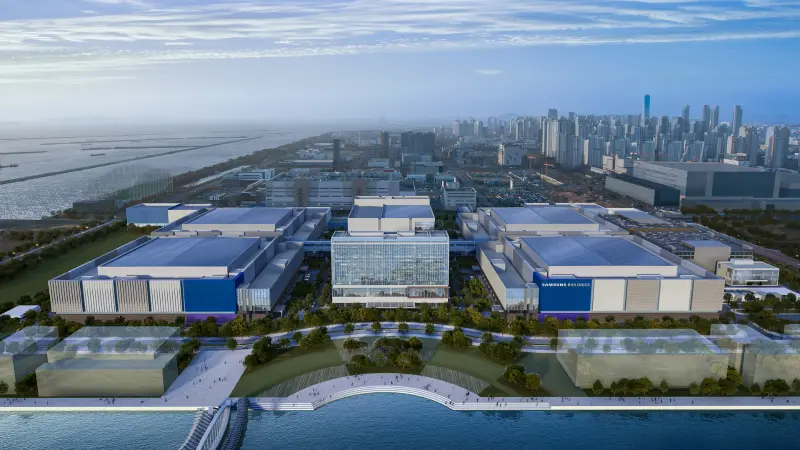
To appreciate this figure, compare it to the CDMO division of Lonza, the global leader by reputation. Lonza’s biologics segment operates at roughly 33–35% margins. Samsung Biologics is 10+ percentage points higher. The difference comes down to scale economics: Samsung operates the world’s largest single-site biomanufacturing campus in Songdo, South Korea, where five plants share infrastructure, utilities, and workforce. Fixed costs are distributed across a massive output base, creating a margin advantage that widens with each additional plant.
The growth trajectory tells a story
Revenue has grown from $2.1B in 2022 to $3.1B in 2025 — a 48% increase in three years. But what’s notable is the acceleration: 2022 to 2023 was essentially flat (a digestion year after Plant 4’s initial ramp), then 2024 saw a 14% jump to $2.4B, and 2025 exploded with 30% growth. Operating profit growth was even more dramatic — from $610M in 2022 to $1.42B in 2025, a 133% increase. The margin expansion from 29.1% to 45.4% over three years reflects the powerful operating leverage inherent in the CDMO model: once a bioreactor is validated and running, incremental revenue flows almost directly to the bottom line.
The quarterly trajectory within 2025 reinforces this momentum. Q3 was the breakout quarter — revenue hit $1.14B (₩1.66T) with $500M (₩728.8B) in operating profit, reflecting full-scale Plant 4 operations. Q4 came in at $880M (₩1.29T) in revenue with $362M (₩528B) in operating profit — a sequential decline that raised eyebrows, but was largely explained by seasonal maintenance schedules and batch timing. Investors will be watching Q1 2026 results (due April 29) for confirmation that the Q3 run-rate is the new normal, not the exception.
Orders outpace revenue — the backlog is the business
Annual orders of $4.1B exceeded 2025 revenue of $3.1B. This means the company already has contracted demand for capacity it hasn’t yet built. Cumulative orders have reached $21.2 billion across 107 CMO contracts and 164 CDO contracts. In 2025 alone, Samsung Biologics signed three mega-deals exceeding $700M each. When 17 of the top 20 global pharma companies are your customers, the pipeline is structurally robust.
The balance sheet supports continued expansion. Total assets stand at $7.6B (₩11.1T), with a debt-to-equity ratio of just 48.4% and a borrowing ratio of 12.3%. For a company investing billions in new plants and a U.S. acquisition, this is remarkably conservative. Cash generation from operations is funding growth internally.
The numbers are compelling. But any thorough Samsung Biologics analysis must go beyond the income statement. What makes this business model so profitable in the first place?
How Samsung Biologics Makes Money — Business Model Breakdown
Samsung Biologics’ business model can be summarized in one sentence: build the world’s largest biopharmaceutical factories, then manufacture drugs for global pharma companies under long-term contracts. The industry calls this CDMO — Contract Development and Manufacturing Organization. Following a 2025 corporate spin-off that separated its biosimilar subsidiary Samsung Bioepis, Samsung Biologics became a pure-play CDMO.
Pillar 1 — CMO (Contract Manufacturing): The Revenue Engine
CMO is the core: large-scale commercial production of biologics that customers have already developed. This includes monoclonal antibodies, fusion proteins, and other large-molecule therapeutics. Samsung Biologics’ standalone revenue — excluding Bioepis — reached approximately $2.4B (₩3.5T) in 2025, dominated by CMO contracts.
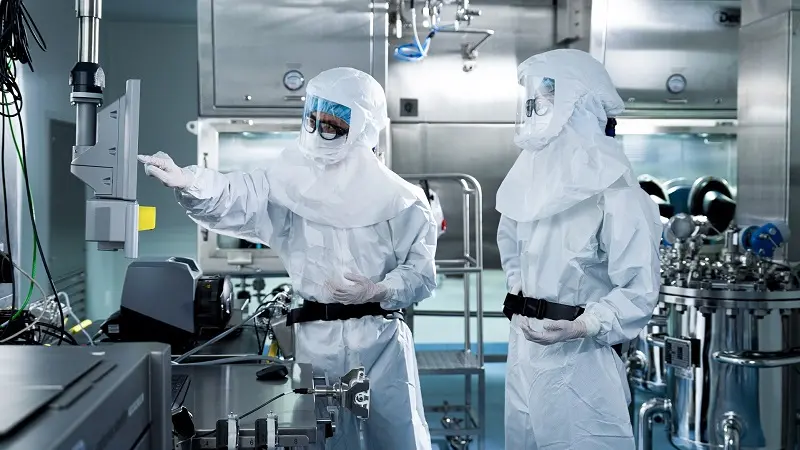
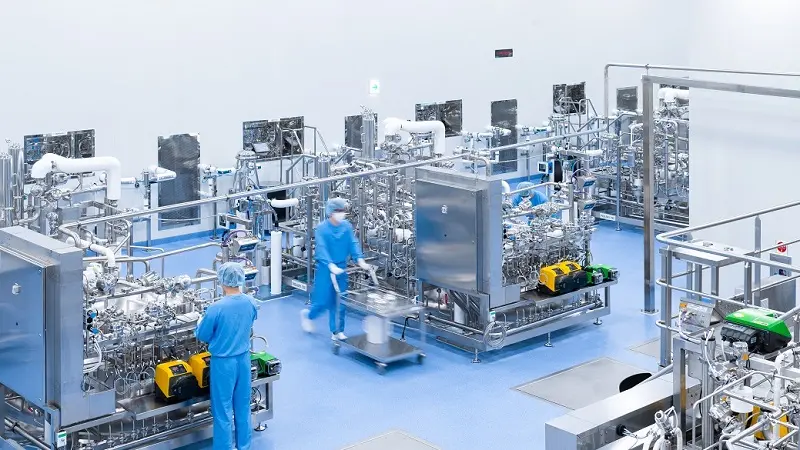
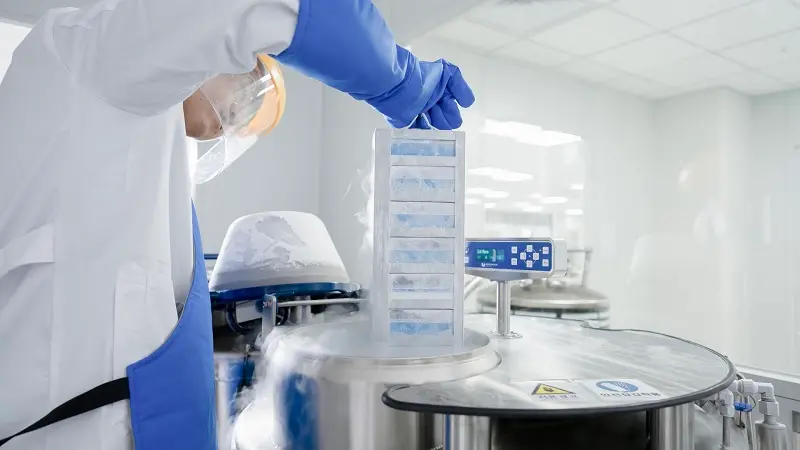
Why is this so profitable? Biologic manufacturing is extraordinarily complex. Living cells are cultured in massive bioreactors, and even minor deviations in temperature, pH, or agitation speed can destroy an entire batch worth millions. The ability to execute this process consistently at 15,000-liter scale across hundreds of batches annually is Samsung’s core competence. For big pharma, outsourcing to Samsung is cheaper and less risky than building their own $2B+ plants.
The competitive position is formidable. Samsung’s Songdo campus — five plants totaling 785,000 liters — is the largest single-site biologics facility on Earth. Adding the newly acquired Rockville, Maryland plant (60,000L) brings global capacity to 845,000 liters. Lonza’s total capacity across all global sites is approximately 500,000 liters. The gap is enormous and widening.
Pillar 2 — CDO (Contract Development): Locking in Future Revenue
CDO covers pre-commercial services: cell line development, process optimization, analytical method development, and clinical-stage manufacturing. This is strategically critical because once Samsung develops the manufacturing process for a drug candidate, switching to a different CDMO for commercial production would require extensive re-validation — a process costing years and millions of dollars. CDO customers become CMO customers almost automatically.
With 164 cumulative CDO contracts, Samsung has a deep pipeline of future commercial manufacturing revenue. Think of each CDO contract as a call option on multi-year CMO revenue that activates upon drug approval.
Pillar 3 — Portfolio Expansion: Beyond Antibodies
Samsung Biologics has historically focused on monoclonal antibodies (mAbs). But the biopharma landscape is evolving rapidly. The company has built ADC (antibody-drug conjugate) production capabilities, secured mRNA vaccine manufacturing capacity, and launched “Samsung Organoids” for preclinical services. In 2025, it signed a strategic vaccine production partnership with CEPI (Coalition for Epidemic Preparedness Innovations), positioning itself as a priority manufacturer for pandemic response.
The company is also expanding into drug product (DP) manufacturing — the fill-and-finish stage that transforms bulk drug substance into injectable formats. By offering end-to-end CRDMO services (Contract Research, Development, and Manufacturing), Samsung eliminates the need for customers to coordinate with separate DP providers, further increasing switching costs and customer retention.
The “what if it didn’t exist” test
If Samsung Biologics vanished tomorrow, 17 of the top 20 global pharma companies would face production disruptions for critical biologics. The only facility of comparable scale is Lonza — which is already running at full capacity. Biologics are not generic pills; they treat cancer, autoimmune diseases, and rare conditions where patients are literally waiting for their medicine. Production cannot be easily transferred. This is Samsung Biologics’ irreplaceability in a single sentence: it is infrastructure that cannot be easily rebuilt.
I covered a complementary angle in Taekwang (023160) Analysis, examining how Korean industrial companies capture value in global supply chains through manufacturing excellence.
Now that we understand the business, let’s zoom out to the industry forces amplifying Samsung’s position.
Why CDMO Now — The Bigger Picture
The global biologics market is valued at approximately $480 billion in 2025 and is projected to grow at 8–10% CAGR through 2030. Within this, the CDMO sub-segment — outsourced biologics manufacturing — is a $30 billion market heading toward $50B+ by 2030. Three structural forces are driving this acceleration.
Megatrend: Big pharma is exiting manufacturing
Building a biologics plant costs $1.5–2.5 billion and takes 3–5 years. With 90% of drug candidates failing in clinical trials, building a dedicated plant before approval is a massive gamble. The trend is clear: pharma companies are outsourcing more production to CDMOs, converting fixed costs into variable costs. Post-COVID, this trend has accelerated as companies witnessed how quickly contract manufacturers could scale production.
Regulatory and policy tailwinds
The U.S. BIOSECURE Act (signed December 2025 as part of NDAA FY2026) prohibits U.S. government agencies from contracting with designated Chinese biotech companies, including WuXi Biologics and WuXi AppTec. Existing contracts are grandfathered until 2032, but the signal is unmistakable: new drug development programs are being steered away from Chinese CDMOs. Given that drug development takes 10–15 years, pharma companies are already redirecting new contracts to non-Chinese manufacturers.
The EU is pursuing similar supply chain resilience goals through its Critical Medicines Act, promoting domestic or ally-sourced production of essential medicines. Japan is expanding its biomanufacturing footprint. The global direction converges on one theme: produce biologics in trusted, allied nations. South Korea — and Samsung Biologics specifically — sits at the center of this realignment.
Five years ago vs. today
In 2020, Samsung Biologics had three plants with 362,000L capacity and $1.7B in revenue. Today: five plants, 845,000L (including Rockville), $3.1B revenue, and a $21.2B cumulative order book. Capacity has more than doubled. Revenue has nearly doubled. The order backlog has grown even faster. Samsung’s position in the value chain is clear: it is the central manufacturing node in the biologics supply chain, sitting between drug developers (pharma) and patients (healthcare systems).
I explored how Korean companies capture similar structural positions in SK Hynix Analysis. Just as SK Hynix dominates HBM for AI chips through manufacturing prowess, Samsung Biologics dominates biologics production through scale and execution.
With the industry context established, let’s examine the specific investment catalysts.
Samsung Biologics Analysis: 3 Reasons to Watch This Stock
Catalyst 1 — The BIOSECURE Act Is Structural, Not Cyclical
The forced migration of CDMO contracts away from China creates a multi-year tailwind that benefits Samsung Biologics disproportionately.
WuXi Biologics generated approximately $2.3 billion in revenue in 2024, a significant portion from Western pharma clients. While not all of this will shift immediately, new contract decisions are already being influenced. Samsung Biologics’ 2025 order surge to $4.1B likely reflects early BIOSECURE Act reallocation. The key insight: this isn’t a one-time event. As long as the law remains in effect, every new drug development program will factor in CDMO geography. Samsung, with established relationships with 17 of the top 20 pharma companies, is the default alternative.
NH Investment Securities called Samsung Biologics the “undisputed CDMO champion that will outperform Lonza in 2026,” citing BIOSECURE as a core structural advantage. Timeline: detailed implementation rules expected in H1 2026, which could trigger another wave of contract announcements.
Catalyst 2 — Plant 5 + Rockville = Capacity Quantum Leap
Two capacity expansions are happening simultaneously: the world’s largest biologics plant ramping up, and Samsung’s first U.S. production footprint coming online.
Plant 5 (180,000L) began operations in April 2025 and is undergoing FDA/EMA GMP validation. Based on Plant 4’s ramp trajectory, meaningful revenue recognition should begin in H2 2026 or early 2027. At full utilization, Plant 5 alone could contribute $700M+ in incremental annual revenue.
The Rockville, Maryland acquisition (~$275M, 60,000L) addresses Samsung’s single biggest strategic gap: the absence of a U.S. production facility. For American pharma companies concerned about supply chain proximity and regulatory alignment, a domestic manufacturing option eliminates a key objection. This facility wasn’t included in Samsung’s 2026 guidance of +15–20% revenue growth, meaning actual growth could reach 25% once Rockville revenue is consolidated.
Samsung’s construction speed is itself a competitive advantage. Plant 3 took 35 months to build. Plant 5 took 24 months — 11 months faster for the same 180,000L capacity. Competitors typically need 3–4 years for comparable facilities. Speed is capacity, and capacity is order competitiveness.
Catalyst 3 — The 45% Margin Is Structural, Not Temporary
Samsung Biologics’ industry-leading profitability stems from a scale advantage that competitors cannot easily replicate.
CDMO economics heavily favor scale. Fixed costs (depreciation, labor, utilities) are distributed across production volume, while variable costs (raw materials) scale linearly. Samsung’s five co-located plants in Songdo share infrastructure, laboratory facilities, quality systems, and management overhead — creating efficiency that a geographically dispersed competitor cannot match.
The comparison with Lonza is instructive. Lonza operates biologics sites in Switzerland, the U.S., Singapore, and China — each requiring separate management layers, regulatory compliance teams, and utility infrastructure. Samsung concentrates everything in one optimized campus. The result: a 10+ percentage point margin advantage that compounds with each additional plant. This is a flywheel: higher margins fund faster construction, which adds capacity, which drives more orders, which further dilutes fixed costs.
There’s an underappreciated dimension to this margin story: Samsung’s proprietary cell line development platform, S-CHOice, delivers industry-leading expression levels — meaning more drug per liter of bioreactor capacity. Higher yield per batch translates directly into lower unit production costs, further widening the profitability gap versus competitors who rely on generic cell line technologies. This is operational excellence embedded into biology itself.
I covered a structurally similar dynamic in Hyosung Heavy Industries Analysis — where scale-driven margin advantages in power transformers mirror what Samsung Biologics achieves in biomanufacturing.
Now let’s examine what could go wrong.
The Bear Case — Risks You Need to Know
No investment thesis is complete without examining the counterarguments. Here’s how the bull and bear factors stack up.
| ✅ Bull Factors | ⚠️ Bear Factors |
|---|---|
| World’s largest biologics capacity (845,000L) | P/E of ~62x — premium to every global peer |
| 45% operating margin, 10pp+ above Lonza | Single-site concentration risk (Songdo) |
| BIOSECURE Act driving structural order migration | U.S.-China détente could reduce BIOSECURE impact |
| 17 of top 20 pharma as customers | Customer concentration — top 5 clients are significant |
| Plant 5 + Rockville visible growth drivers | Plants 6–8 require multi-billion-dollar capex |
| CEPI pandemic partnership secured | ADC/mRNA capabilities still commercially unproven |
| Conservative balance sheet (48% D/E ratio) | FX sensitivity — revenue in USD, costs partly in KRW |
| CEO continuity (John Rim reappointed for 3rd term) | Zero dividend — all cash reinvested |
Risk 1 — Valuation: Is 62x P/E Already Priced In?
Samsung Biologics trades at approximately 62x trailing earnings — roughly double Lonza’s P/E of 30–35x and far above the KOSPI average of 10–12x. The bull argument is that Samsung’s growth rate (30% revenue, 57% profit) and margin profile (45% vs. Lonza’s 33%) justify the premium. On a PEG basis, Samsung trades at approximately 1.1x — not unreasonable for a high-growth compounder.
The risk materializes if growth decelerates. The 2026 guidance of +15–20% revenue growth is already a step down from 2025’s +30%. If this trend continues toward single-digit growth by 2028, the multiple could compress rapidly. Growth stocks live and die by acceleration. The key question: can Plant 5, Rockville, and BIOSECURE sustain 20%+ growth through 2028?
Risk 2 — Global CDMO Competition Is Intensifying
Samsung isn’t building alone. Lonza is expanding capacity. India’s Biocon is scaling aggressively on cost advantages. WuXi Biologics, though impacted by BIOSECURE in the U.S., retains strong positioning in China’s domestic market and non-U.S. geographies. If global CDMO capacity eventually outstrips demand, pricing pressure could erode Samsung’s margins.
There’s a subtler competitive risk too. Samsung Biologics’ dominance is concentrated in mammalian cell culture — specifically large-scale monoclonal antibody production. But the biopharma pipeline is shifting toward newer modalities: ADCs, bispecific antibodies, cell and gene therapies, and mRNA platforms. Each requires different manufacturing capabilities and infrastructure. Samsung has invested in these areas, but Lonza has a longer track record in ADCs and cell/gene therapy, and smaller specialists like AGC Biologics and Catalent (now part of Novo Holdings) have established niches. If the modality mix shifts faster than Samsung can adapt, its capacity advantage in traditional mAb production may become less relevant.
However, CDMO is a heavily regulated industry where building and validating a new facility takes 3–5 years. New entrants cannot flood the market overnight. Combined with 8–10% annual growth in biologics demand and increasing outsourcing rates, a structural supply glut appears unlikely in the medium term.
Despite these risks
Both risks are about growth speed, not business model viability. As long as the global biologics market expands and pharma companies continue outsourcing production, the world’s largest CDMO will not run out of orders. The valuation concern is valid but manageable through position sizing and dollar-cost averaging rather than avoidance.
With both sides of the argument examined, here’s my personal take.
My Take — Here’s How I See Samsung Biologics
Let me be direct. Samsung Biologics is expensive. A 62x P/E gives any value investor pause. But this is a company where the business model quality — 45% margins, 17 of 20 top pharma clients, world’s largest capacity, BIOSECURE tailwind — justifies patient capital rather than dismissal. The question isn’t whether Samsung Biologics is a great company. It is. The question is whether it’s a great stock at this price.
Samsung Biologics isn’t a stock you avoid because it’s expensive. It’s one you accumulate on weakness.
Bull scenario
BIOSECURE implementation rules are finalized in H1 2026, triggering a wave of mega-contract announcements from U.S. pharma companies. Plant 5 GMP approval comes ahead of schedule, contributing revenue from Q3 2026. Rockville integration proceeds smoothly. Result: 2026 revenue reaches $3.8–4.0B, operating profit exceeds $1.7B. The stock re-rates toward the analyst consensus target of $155 (₩2.25M).
Bear scenario
U.S.-China relations improve faster than expected, weakening the BIOSECURE Act’s practical impact. Global CDMO capacity additions from competitors start to pressure pricing. Plant 5 GMP validation is delayed. Result: 2026 revenue lands at the low end of guidance (+15%), the P/E compresses to 50x, and the stock corrects 15–20% from current levels.
Currently trading at approximately $109 (₩1.59M) — about 20% below its 52-week high — Samsung Biologics has 25 analysts covering it, all with Buy ratings. The consensus target of $155 implies 42% upside. That level of unanimity in coverage is unusual and reflects high confidence in the growth trajectory.
Samsung Biologics FAQ
Q. What exactly is a CDMO?
A CDMO (Contract Development and Manufacturing Organization) develops manufacturing processes and produces drugs on behalf of pharmaceutical companies. Think of it as a semiconductor foundry — like TSMC — but for biologics. The pharma company designs the drug; the CDMO makes it at commercial scale with consistent quality. Samsung Biologics is the largest biologics-focused CDMO in the world.
Q. How does Samsung Biologics compare to Lonza?
Samsung leads in scale (845,000L vs. ~500,000L) and profitability (45% vs. ~34% margin). Lonza has a broader geographic footprint and a more diversified portfolio including small molecules. Samsung is concentrated on large-molecule biologics with a single-campus model that maximizes efficiency. They’re complements as much as competitors — the market is growing fast enough for both.
Q. Can global investors buy Samsung Biologics stock?
Yes. Samsung Biologics trades on the Korea Exchange (KRX) under ticker 207940.KS. International investors can access it through global brokerages that offer Korean market access (Interactive Brokers, Saxo Bank, etc.). There is no ADR. Note that foreign ownership is subject to Korean securities regulations. The stock is included in the MSCI Korea Index.
Q. What is the BIOSECURE Act and why does it matter?
The BIOSECURE Act, signed into law in December 2025 as part of the U.S. National Defense Authorization Act, restricts U.S. government agencies from contracting with designated Chinese biotech companies (including WuXi Biologics). This forces pharmaceutical companies to relocate production away from China for any U.S. government-connected work. Samsung Biologics is the primary non-Chinese alternative with sufficient scale to absorb this redirected demand.
Samsung Biologics Analysis: The Bottom Line
One. Samsung Biologics is the world’s largest biologics CDMO by capacity (845,000L) and the most profitable (45% operating margin). Its 2025 results — $3.1B revenue, $1.4B operating profit — represent the strongest performance in Korean biopharma history. The margin advantage over Lonza is structural, driven by single-site scale economics that competitors cannot easily replicate.
Two. Three growth catalysts are converging simultaneously: the BIOSECURE Act redirecting CDMO contracts away from China, Plant 5 ramping up to add $700M+ in annual capacity, and the Rockville acquisition giving Samsung its first U.S. manufacturing footprint. The 2026 guidance of +15–20% growth excludes Rockville revenue, creating built-in upside potential.
Three. The primary risk is valuation: 62x P/E demands sustained high growth to justify. If growth decelerates below 15% or BIOSECURE loses teeth, multiple compression is inevitable. But as long as the biologics market grows at 8–10% annually and outsourcing trends continue, the world’s largest CDMO will not run out of work.
Samsung Biologics is the infrastructure of modern biopharmaceuticals. Drugs evolve. The factory that produces them endures.
If you found this analysis useful, consider sharing it with fellow investors who follow biopharmaceuticals and Korean markets.
This completes our five-part series covering Korea’s most compelling companies in 2026: Hanwha Aerospace (defense), HD Hyundai Electric (power infrastructure), HD Korea Shipbuilding (shipbuilding), Hyundai Rotem (defense + rail), and Samsung Biologics (biopharma manufacturing). Stay tuned for continued data-driven coverage.
This article is based on data as of April 2026. Updated after quarterly earnings.
Disclaimer: This article reflects the author’s personal research and analysis for informational purposes only. It is not a recommendation to buy or sell any security. Investment decisions and their consequences are the reader’s responsibility. Always verify with the latest filings and consult a qualified financial advisor.